Skip to content
REPORT 2026

2026: The AI Value Gap

Bridging Ambition and Execution in the Mid-Market

New research exploring how UK organisations are moving beyond AI pilots to deliver measurable business value, and the barriers preventing progress at scale.

Key Findings

  • 49% of executives say AI initiatives have failed to deliver value or underwhelmed
  • 47% of executives have scaled AI pilots into production
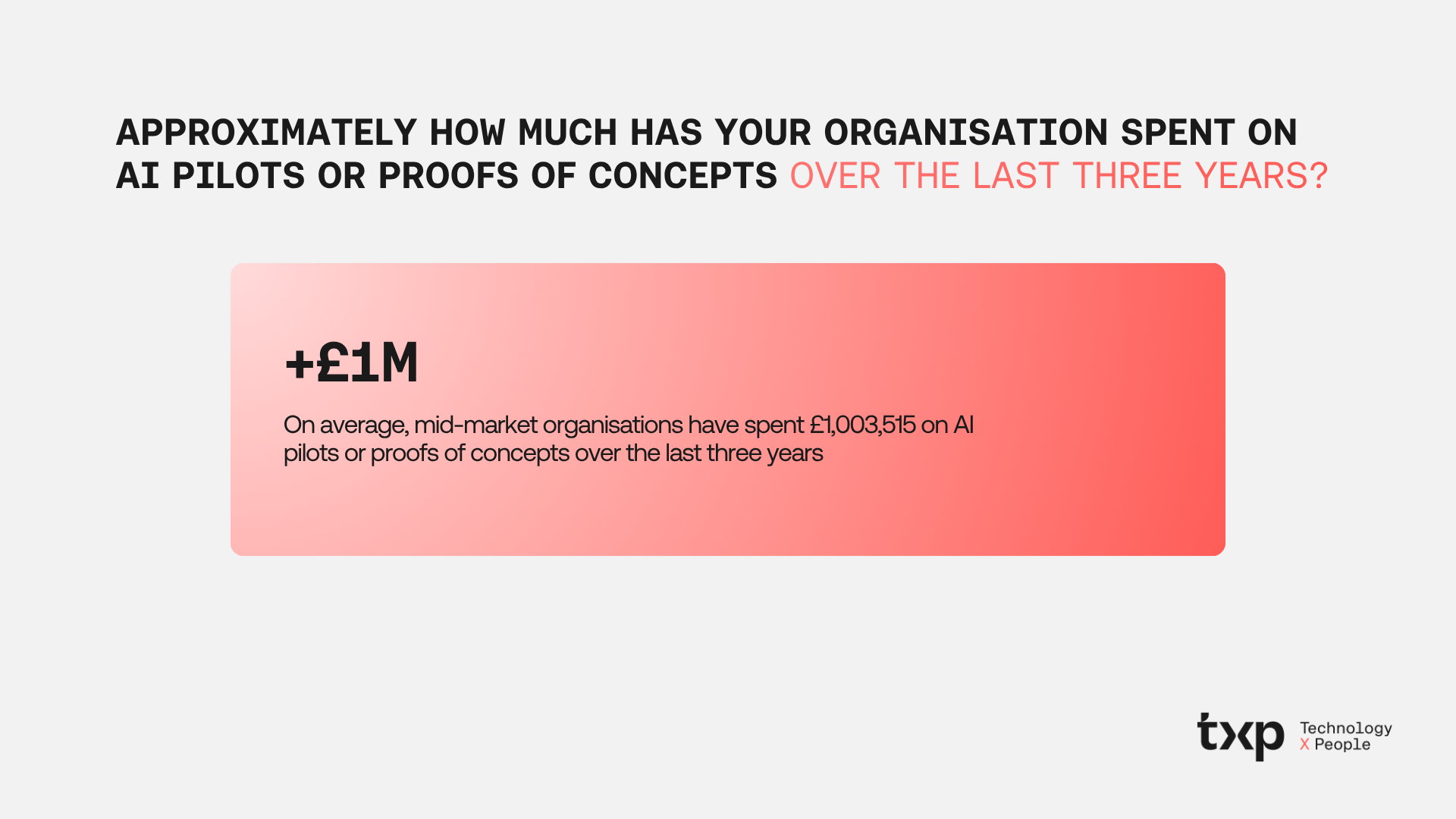
  • The average spend across organisations on pilots and proofs of concept in three years is +£1m
  • 98% of executives already have an AI strategy - ambition isn't the gap

Executive Summary

As AI maturity grows, the question is no longer whether it can help organisations. Companies, industries and economies are already being reshaped by AI, placing mid-market organisations at the centre of an exciting period of change. Strategies are in place and budgets have been allocated. The focus now is on learning from early experiments, accelerating progress and applying AI in ways that advance business and strategic objectives.

At the same time, AI capabilities are becoming increasingly commoditised, much as internet and cloud technologies did before them. As the market consolidates around a small pool of frontier and open-source models, the technology alone offers limited scope for differentiation. The opportunity lies instead within each organisation. Proprietary data, internal expertise and the institutional knowledge held by its people can provide the backbone for distinctive solutions that create lasting competitive advantage.

Encouragingly, this study finds that most mid-market organisations have laid the foundations for AI success. The next phase is more nuanced, building on these promising beginnings and turning ambition into execution. Doing so will depend on combining technology with deep organisational knowledge, understanding and expertise that people hold.

For this report, we gathered insight from business leaders responsible for IT and AI strategy at UK mid-market organisations. Respondents work across the public sector, (including central government and healthcare), banking and insurance industries.

Strong foundations and a clear pathway 

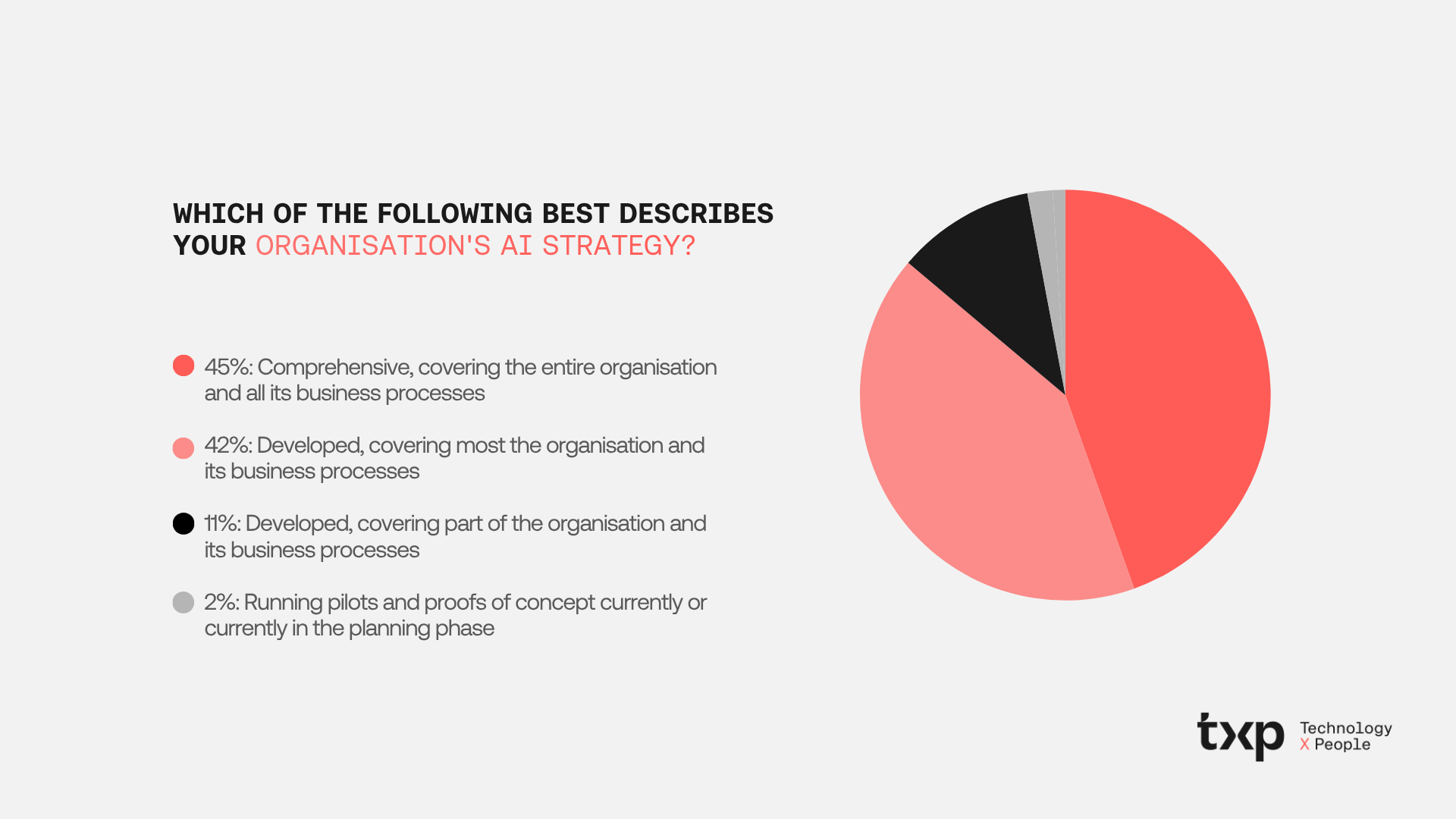
Mid-market organisations have made significant progress in developing their AI strategies. Almost half (45%) of business leaders say their strategy is comprehensive, covering the entire organisation and all business processes. A further 42% say it covers most of the business, while just 2% remain in the pilot or planning stages. 

org-ai-strategy

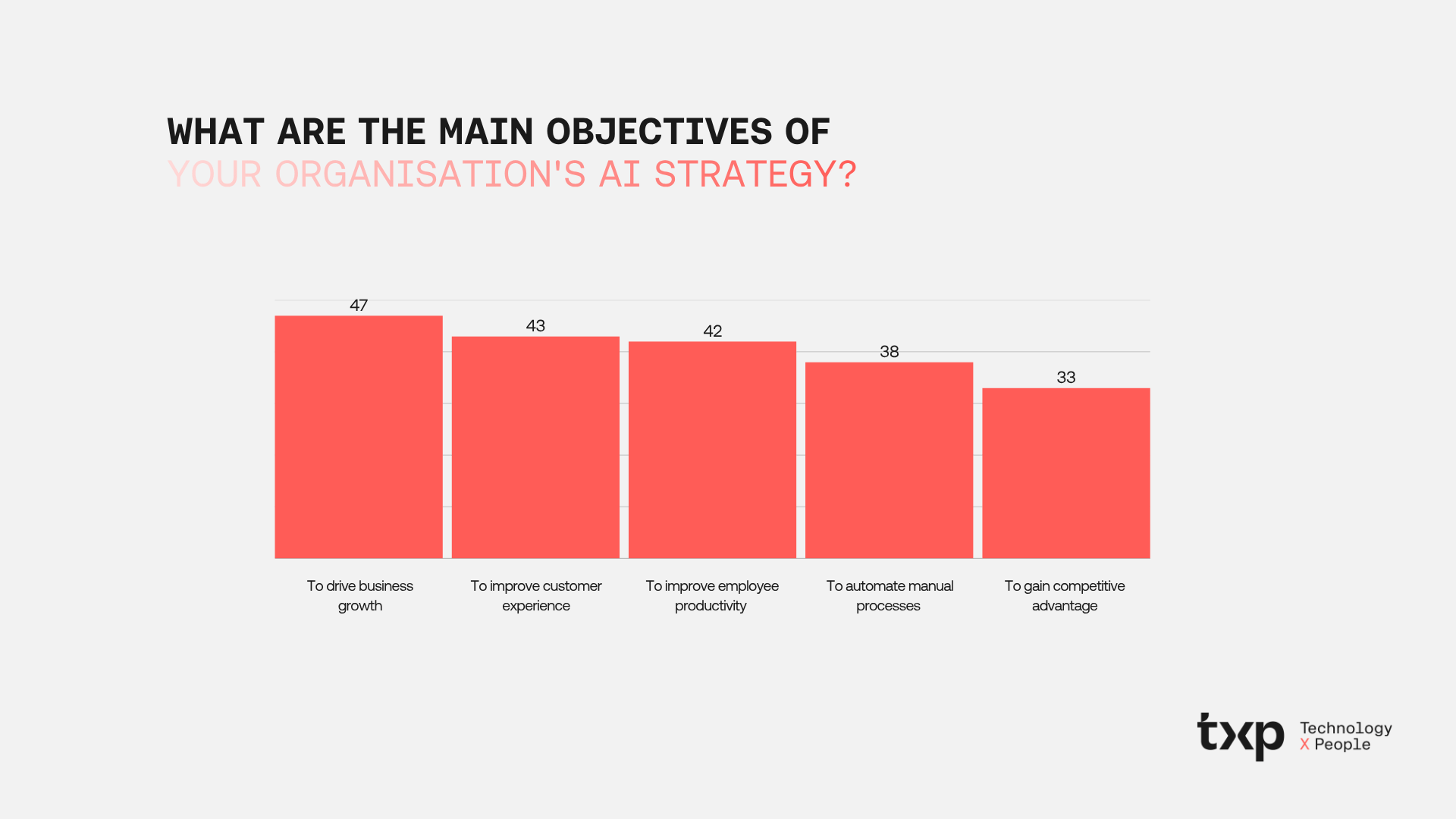
These strategies are focused on clear business priorities. Driving growth, improving customer experience and increasing employee productivity emerged as the three leading objectives for AI.
 

objectives-ai

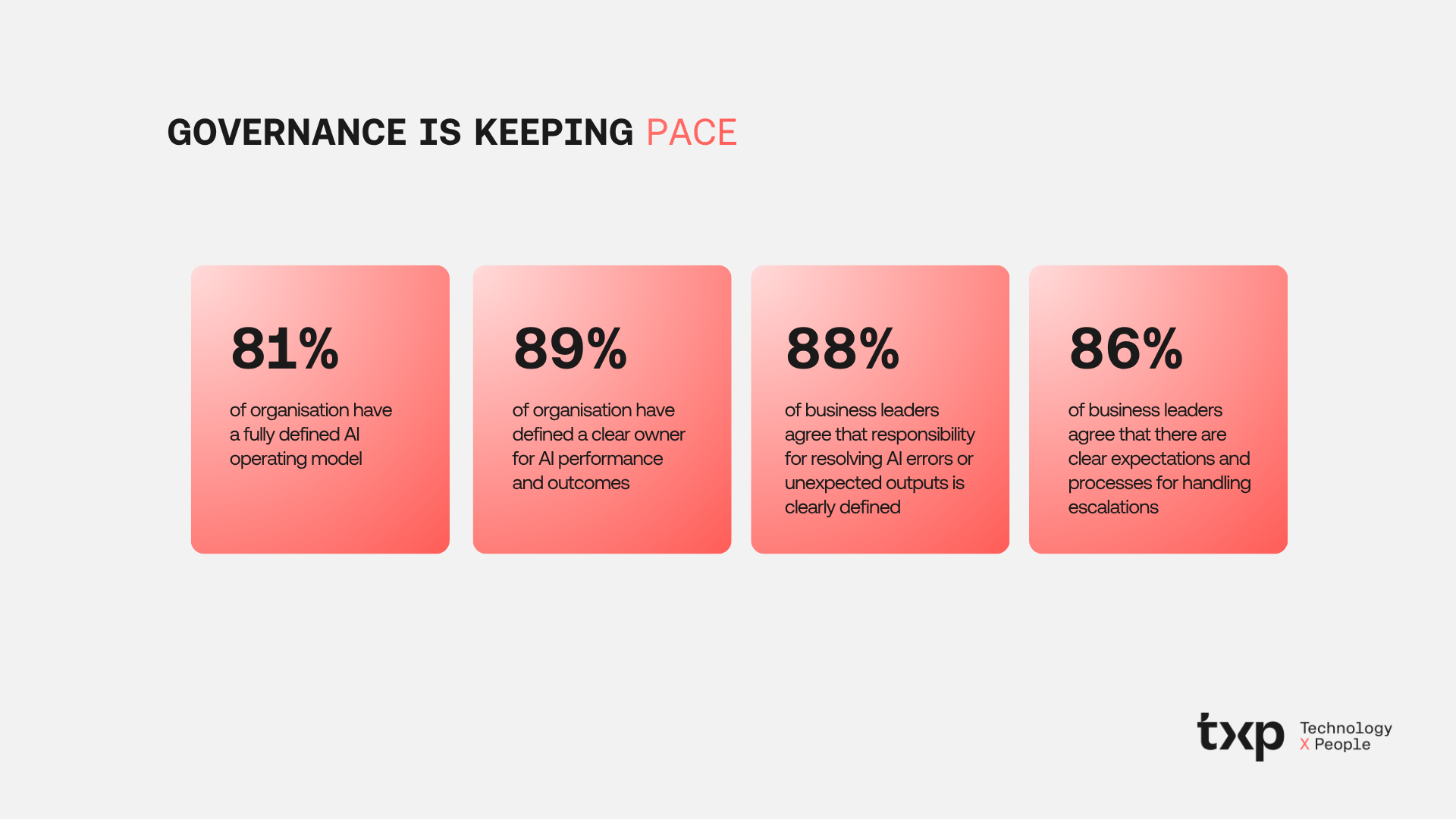
Business leaders are also confident in the governance and operating structures supporting AI within their organisation. Four-in-five (81%) agree that an AI operating model has been fully defined, while 89% say ownership of AI performance and outcomes is in place. Almost nine-in-ten (88%) agree that responsibility for resolving AI errors or unexpected outputs is clear, while 86% report having defined expectations and processes for handling escalations.  

governance-pace

It’s clear that most mid-market organisations see AI as a springboard for innovation and growth. The vast majority have developed a strategy and aligned it with clear business goals, providing strong foundations for progress. Attention must now turn to giving AI the organisational context and direction it needs to translate those ambitions into meaningful business value.


Making the jump into production

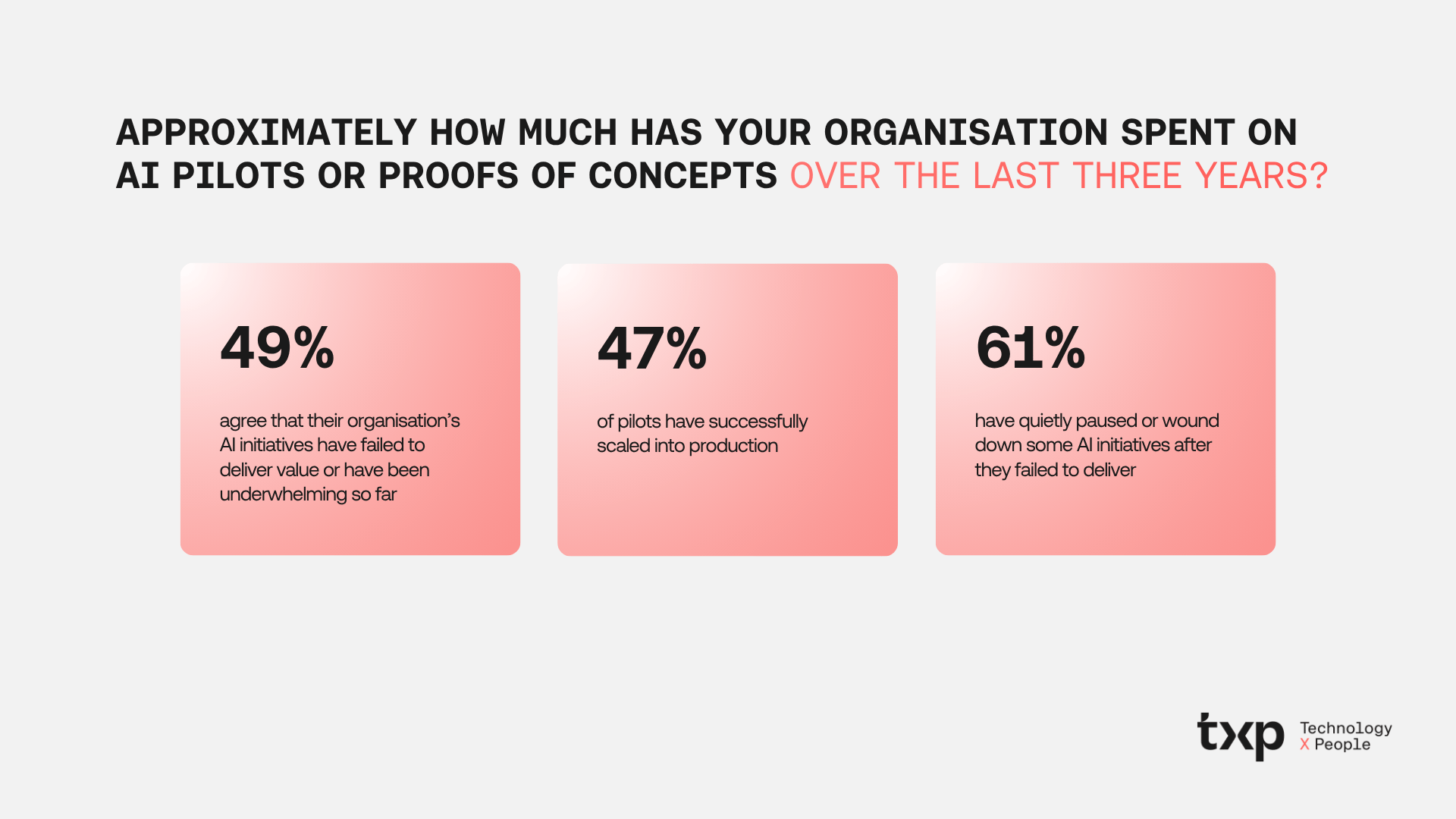
Mid-market organisations have invested an average of just over £1 million in AI pilots and proofs of concept over the past three years, testing where the technology can make the greatest contribution. Nearly half (47%) of these pilots have already scaled into production. However, 61% of business leaders also say their organisation has paused or wound down initiatives that failed to deliver as expected.  

1million-spent

three-year-spend

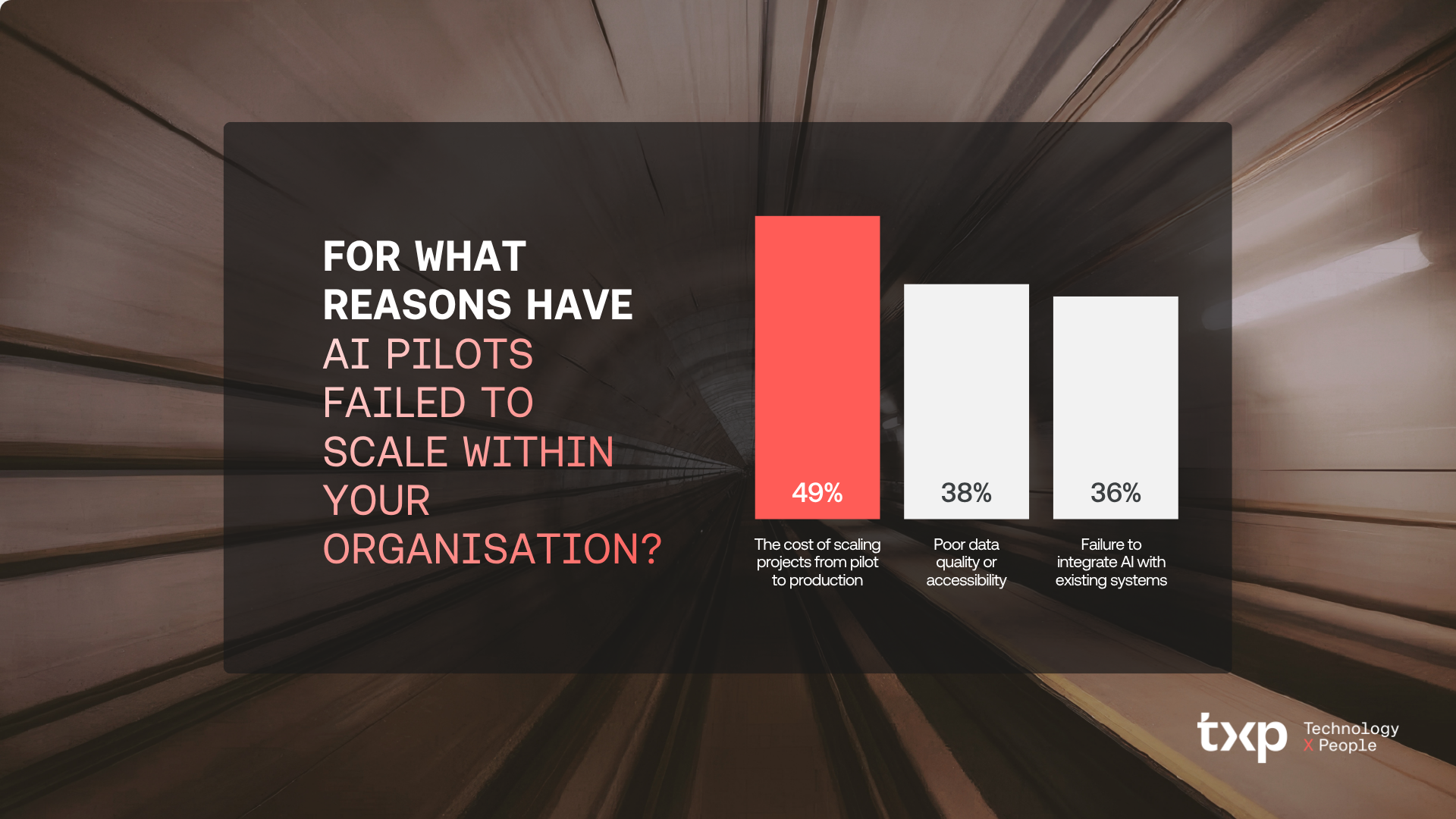
In fact, almost half (49%) of business leaders agree that their AI initiatives have failed to deliver value or have proved underwhelming so far. The most commonly cited barriers to scaling were the cost of moving projects from pilot to production (49%), governance and risk concerns (39%), and poor data quality or accessibility (38%).  

ai-pilots-fail

Mid-market organisations have learned important lessons from their early experiments, deciding which projects to scale into production and which to discontinue. Although many business leaders have been underwhelmed by the results so far, the leading barriers are practical and solvable rather than fundamental limitations of the technology. The next step is to refine the method, resolving the issues exposed by early experiments so that more projects can scale. 


Three priorities for scaling AI

Turning individual expertise into shared capabilities  

The research highlights three areas of focus for mid-market organisations as they look to build on their AI progress to date and generate greater returns from their investments.  

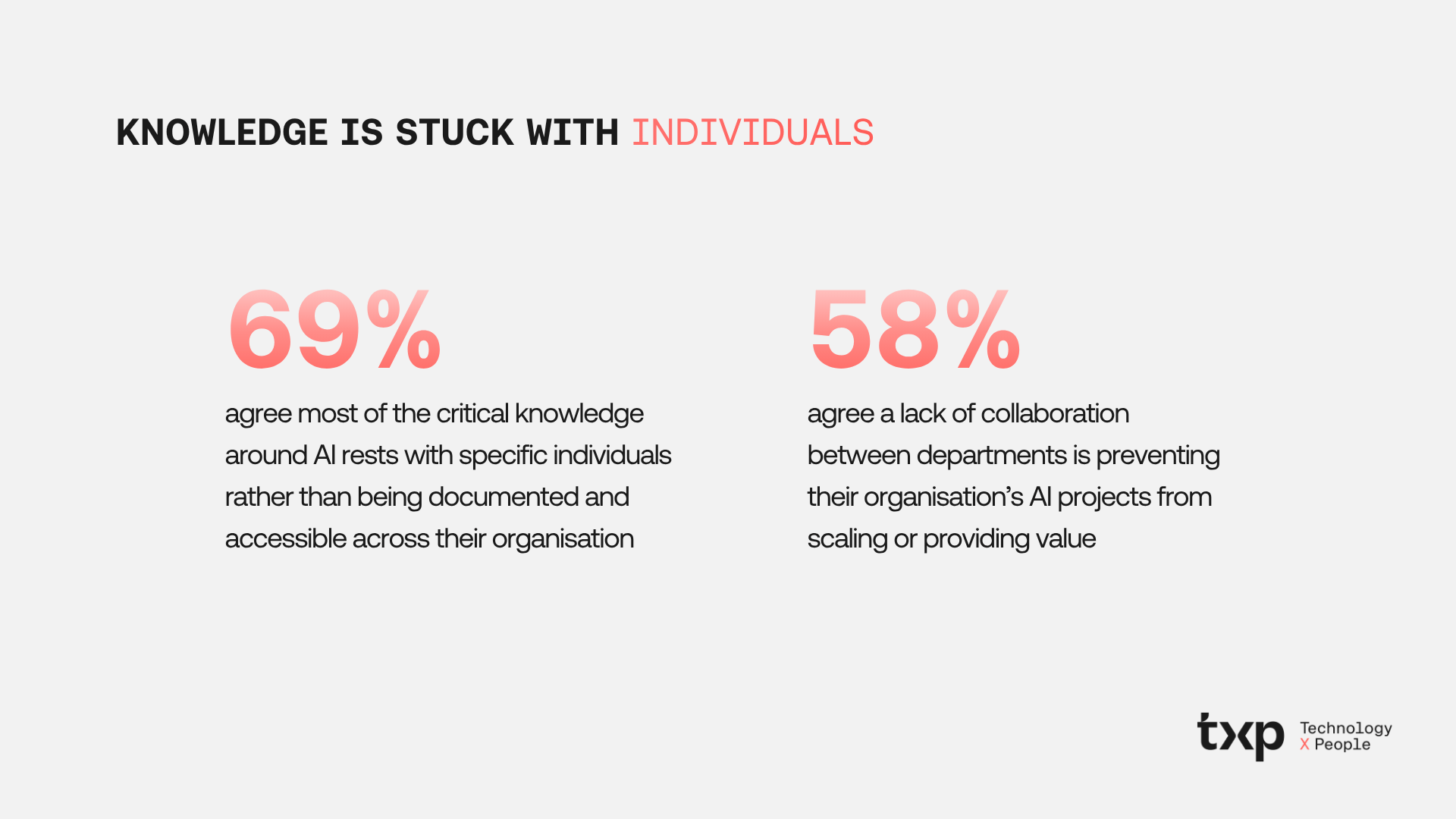
Successful AI programmes depend on collaboration across teams and access to the organisational knowledge that informs decisions. Yet critical knowledge often remains with specific individuals rather than being documented and accessible across the business. Organisations should prioritise capturing this expertise and centralising it, turning knowledge held by individuals into a shared organisational capability.  

knowledge


Designing workflows around AI

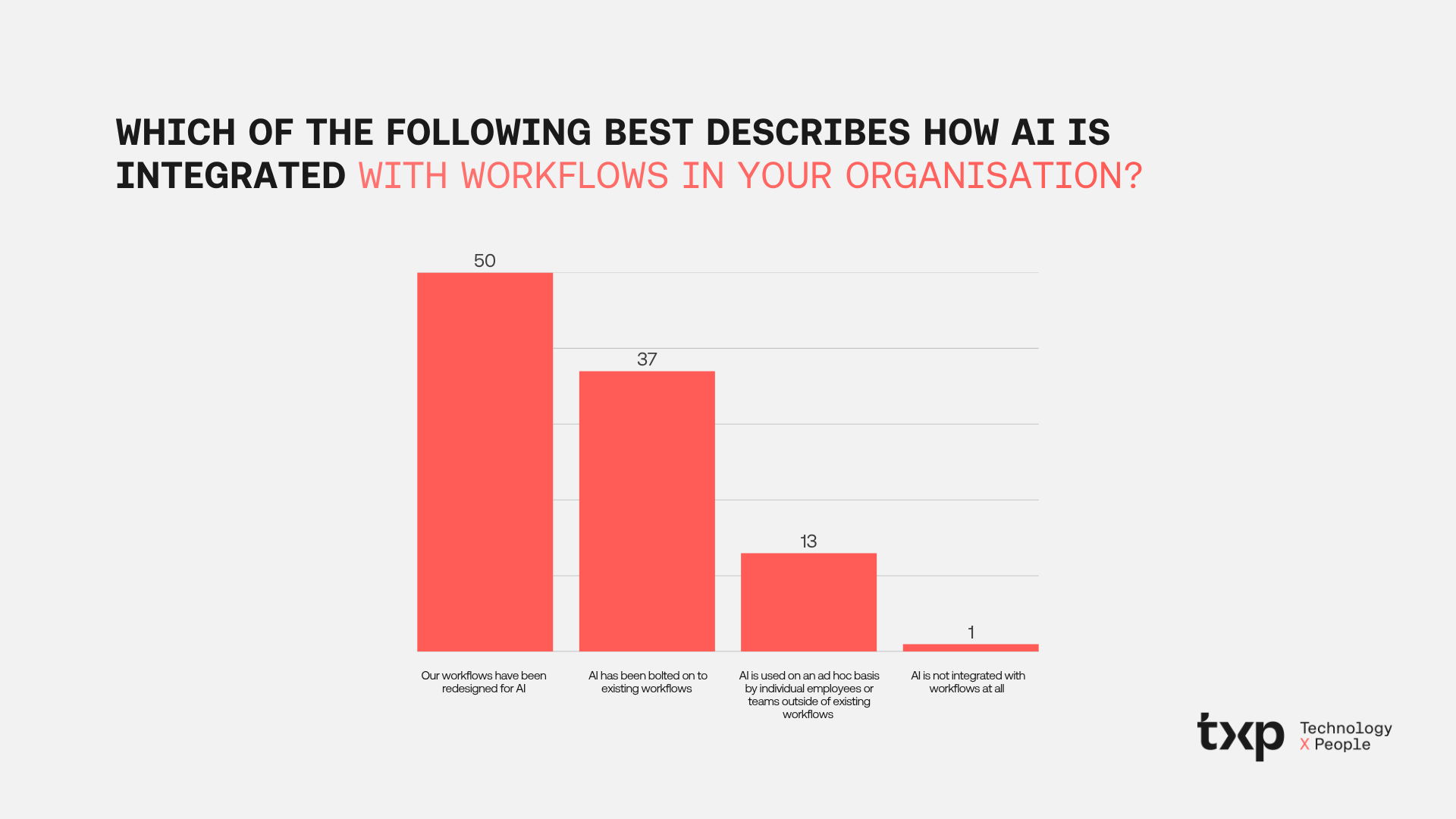
Redesigning workflows around AI is another important step in scaling projects into production. This requires a detailed understanding of business logic, operational policies and existing processes so that AI can be integrated effectively. Half (50%) of organisations have already redesigned their workflows around AI. For those still adding AI to existing workflows or using it on an ad hoc basis, the next step is to identify where processes need to be redesigned, rather than simply bolting AI onto workflows that were never built for it.  

integration


Orchestrating AI across the estate

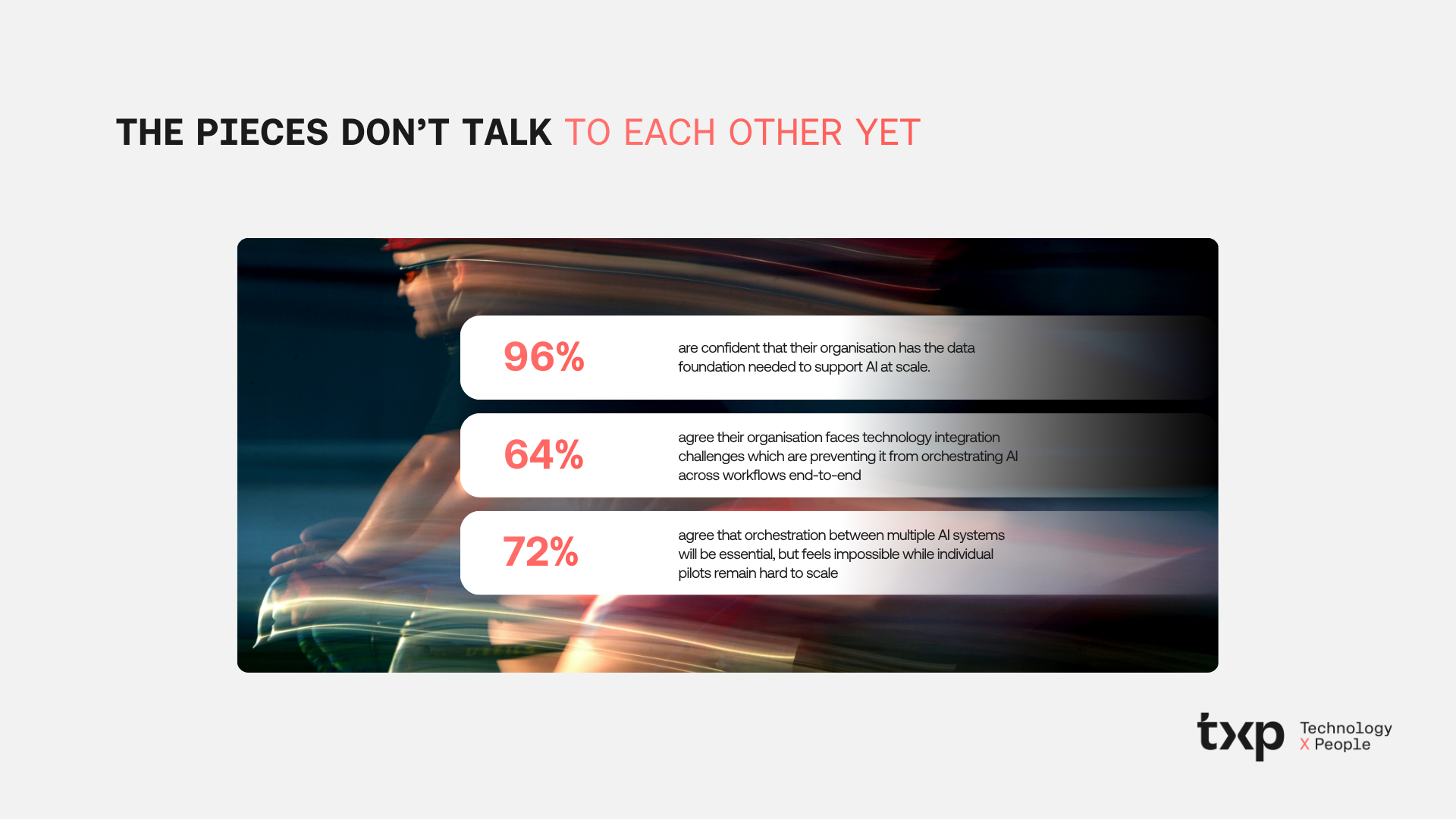
Scaling AI requires effective orchestration across systems, data and workflows. Although almost all business leaders (96%) are confident in their organisation’s data foundations, integration with the wider technology estate remains a barrier to end-to-end orchestration. Looking ahead, business leaders recognise the need to orchestrate multiple AI systems but say this feels impossible while individual pilots remain difficult to scale. Organisations must now map technical dependencies and create a clear roadmap connecting AI with the systems and data that empower it.  

pieces

Redesigning workflows and orchestrating AI across systems require a deep understanding of how an organisation operates. The good news is that this knowledge already exists internally. By capturing the insight surrounding critical systems and processes, business leaders can refine their approach and turn their AI ambitions into demonstrable results.


Discovery multiplies the value of AI investment

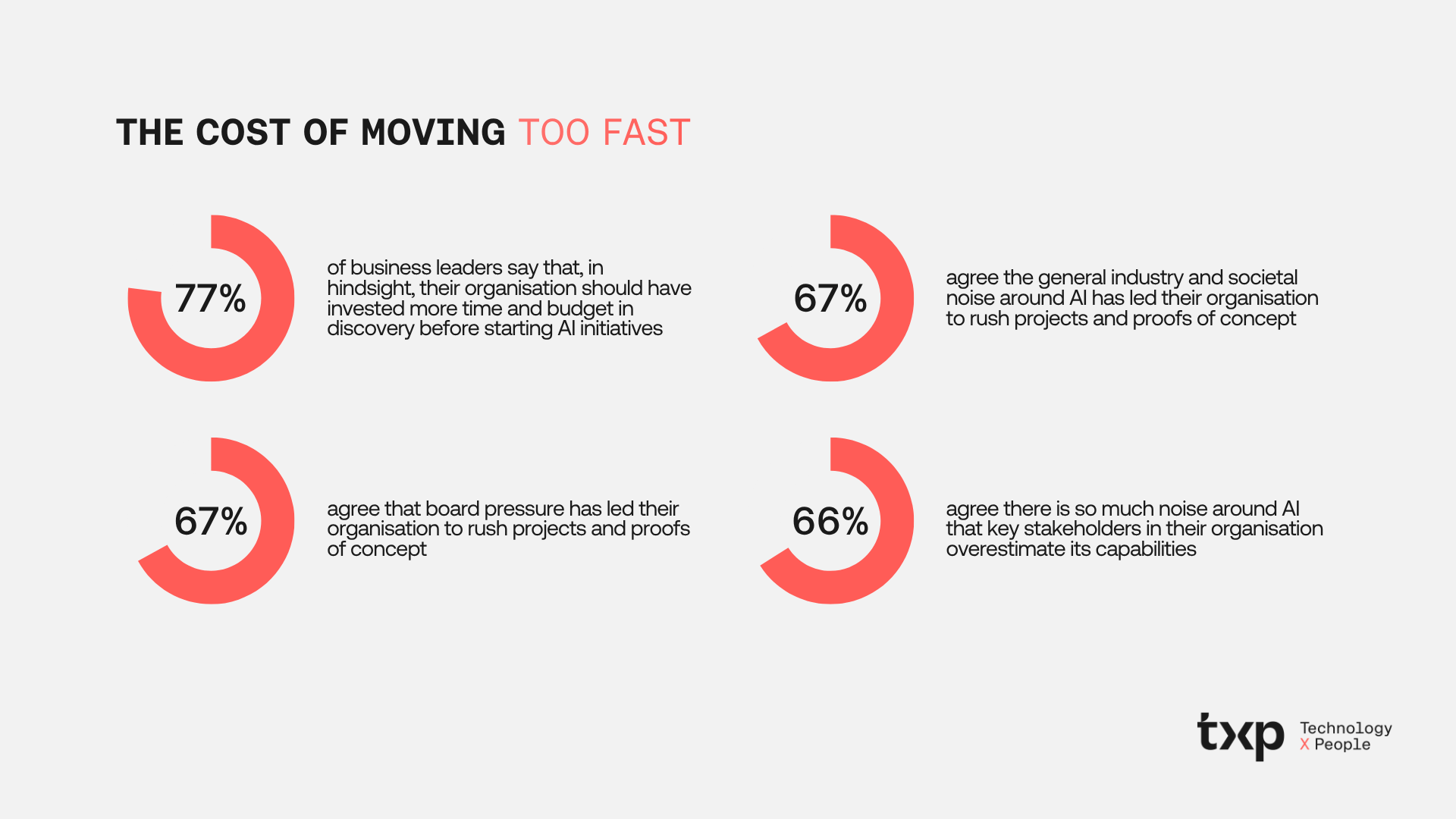
More than three-quarters (77%) of business leaders say that, in hindsight, their organisation should have invested more time and budget in discovery before starting AI initiatives. This is an important lesson that can inform the next phase as organisations look to scale AI and start new projects.

Many business leaders also recognise how external pressures can influence decision-making. Board expectations and industry hype are creating pressure to move quickly as organisations seek to keep pace with competitors. Awareness of these influences is important, as those organisations who can look beyond the noise will be better equipped to set realistic goals and make sound investment decisions.

moving-too-fast

Speed and ambition should not be seen as opposing forces. A focused discovery phase that maps dependencies, assesses technical debt and readiness, identifies priority use cases and captures internal knowledge makes everything downstream faster. This ‘measure twice, cut once’ mindset replaces uncertainty with an evidence-led path forward and exposes operational issues before they become barriers to progress. 


The next phase of AI innovation

Mid-market organisations have already achieved some early success with scaling AI into production, but many are yet to achieve tangible results. The next step is building on these foundations and refining to create a more reliable path to value. Greater focus on discovering, capturing and sharing organisational knowledge can help promising projects overcome barriers and deliver business results.

This starts with drawing out the knowledge held by people across the organisation and making it accessible. That understanding can guide the redesign of workflows, the integration of AI with existing systems and data, and the introduction of new ways of working, providing a stronger basis for applying the lessons learned through early experimentation.

Choosing the right partner will be central to this next phase. Technical skills alone are not enough. A partner must also be able to uncover important – often hidden – information, map dependencies and translate what they learn into practical changes across systems and workflows. Bringing these capabilities together with a deep understanding of the organisation will give more AI projects a clear route to production.

By combining people and technology, TXP helps organisations to turn AI ambitions into execution and deliver outcomes that meet business needs and objectives. Our teams work closely with customers to understand their existing landscape, uncover critical knowledge and build solutions grounded in discovery, collaboration and clear business outcomes.


Methodology

The survey was conducted among 200 UK decision-makers in mid-market organisations involved in IT and AI strategy across central government departments only, healthcare, banking & insurance.

The research was conducted by Sapio research in July 2026. 


Download the full report


AG

Ankur Gupta

Head of AI & Data

Ankur is a Data and AI Strategist, focused on helping organisations turn AI ambition into measurable business outcomes. He works with leaders to connect business priorities, data capabilities and technology investments, creating the foundations for scalable and sustainable AI adoption. 

l-g

Lynda Girvan

Head of Business Analysis

Lynda Girvan is a Principal Business Analyst, focused on helping organisations unlock the knowledge, processes and behaviours that underpin successful AI adoption. She works closely with stakeholders to understand how work gets done today and how organisations can evolve to realise lasting business value from change. 

w-b

Will Barton

Enterprise Sales Director

Will Barton is an enterprise sales leader, working with organisations to understand their challenges, identify the right opportunities for change and build a clear path to delivery. Bringing together business, technology and people perspectives, he helps clients realise lasting value from transformation initiatives and emerging technologies such as AI.

t-h

Tim Hurst

Chief Operating Officer

Tim Hurst is Chief Operating Officer, focused on helping organisations translate strategy into lasting business outcomes. He supports clients in shaping the structures, capabilities and ways of working needed to successfully adopt new technologies, manage change and deliver value at scale.