
cite data quality and governance as the biggest barrier to AI success
IDC, 2025
THE AI CONVERSATION NOBODY'S HAVING
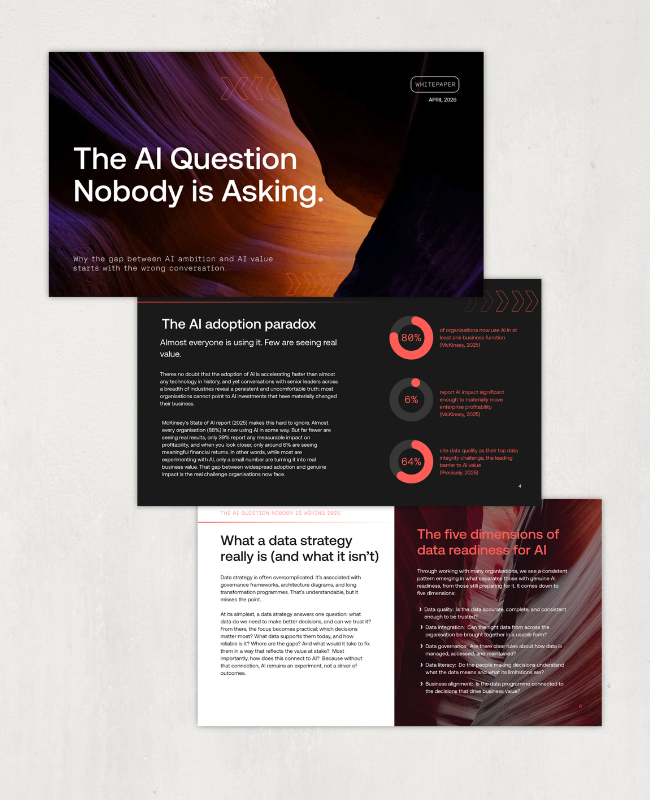
88% of organisations are using AI. Only 6% are seeing meaningful returns. The gap isn't technical, it's strategic. And it starts with asking a different question.
ALMOST EVERYONE IS USING IT
The pattern is consistent across sectors. Pilots run. Demos impress. Slide decks promise transformation. But somewhere between proof of concept and enterprise deployment, progress stalls.

IDC, 2025

Mckinsey, 2025

Gartner, 2025

WHAT SEPERATES THE 6% FROM EVERYONE ELSE?
The organisations extracting real value from AI aren't doing anything extraordinary. They're doing something deliberate. These are the four things they understand that most don't.
Connecting AI investment to business strategy starts with exploring what's possible, not buying more tools. Until you've had that conversation, every AI investment is experimental spend, not strategic investment.
AI amplifies whatever your data tells it. If your data is fragmented, siloed, or incomplete, your AI outcomes will be too. Getting the data foundation right is what separates AI that helps from AI that harms.
You don't need a perfect data estate or a multi-year transformation programme. You need strategic clarity, a focused entry point, and a partner who builds your capability, not your dependency.
THE FIVE DIMENSIONS
Through working with organisations across financial services, professional services, retail, insurance, and the public sector, a consistent pattern emerges. It comes down to five dimensions, and very few organisations are strong across all five.
Is the data accurate, complete, and consistent enough to be trusted? AI amplifies data problems as much as data strengths, quality is the foundation everything else rests on.
Can the right data from across the organisation be brought together in a usable form? Siloed data doesn't just limit AI potential, it actively misdirects it.
Are there clear rules about how data is managed, accessed, and maintained? Governance isn't the blocker, it's the unlock. The organisations moving fastest have the clearest rules, not the most flexible ones.
Do the people making decisions understand what the data means and what its limitations are? Technical excellence without commercial understanding doesn't produce better decisions.
Is the data programme connected to the decisions that drive business value? When data, AI, and business strategy are treated as separate conversations, none of them deliver what they should.
BLOG POST
The phrase ‘data strategy’ has come to mean almost anything. A warehouse migration, a governance committee, a Power BI rollout, a cloud platform decision or a roadmap document that lives in a shared drive and gets dusted off once a year. When all those things can sit under the same heading of ‘strategy’, that framing has stopped being useful.
THE 6% AREN'T DOING ANYTHING EXTRAORDINARY
The organisations that consistently extract value from AI share four characteristics. None of them are primarily about the technology.

Instead of broad ambitions, they focus on specific outcomes — what decision needs to be made better, faster, or more consistently. That clarity shapes everything that follows.

Data quality and governance are ongoing responsibilities, not project-based fixes. Clear ownership and a shared understanding that if the data isn't reliable, nothing built on it will be either.

External partners still play a role, but they don't replace internal understanding. Over time, these organisations become more self-sufficient — not more reliant on whoever built their last model.

Business strategy, data strategy, and technology decisions are addressed together — not in sequence, not in separate departments. That alignment turns isolated AI experiments into outcomes that scale.


Download the white paper. Start the conversation.

TXP works with mid-market organisations to turn AI and digital ambition into measurable outcomes. Our focus is not on increasing activity, it's on improving alignment and connecting business priorities to data foundations and technology delivery.